Most business owners open their P&L, glance at the bottom line, and close it.
That’s like going to the doctor, only checking your weight, and calling it a full physical.
Your P&L is one of the most powerful financial tools you have — but only if you know what you’re actually looking at. After working with hundreds of business owners, here’s exactly how a CFO reads a profit and loss statement — and how you should too.
Start at the Top — Revenue Is Not the Whole Story
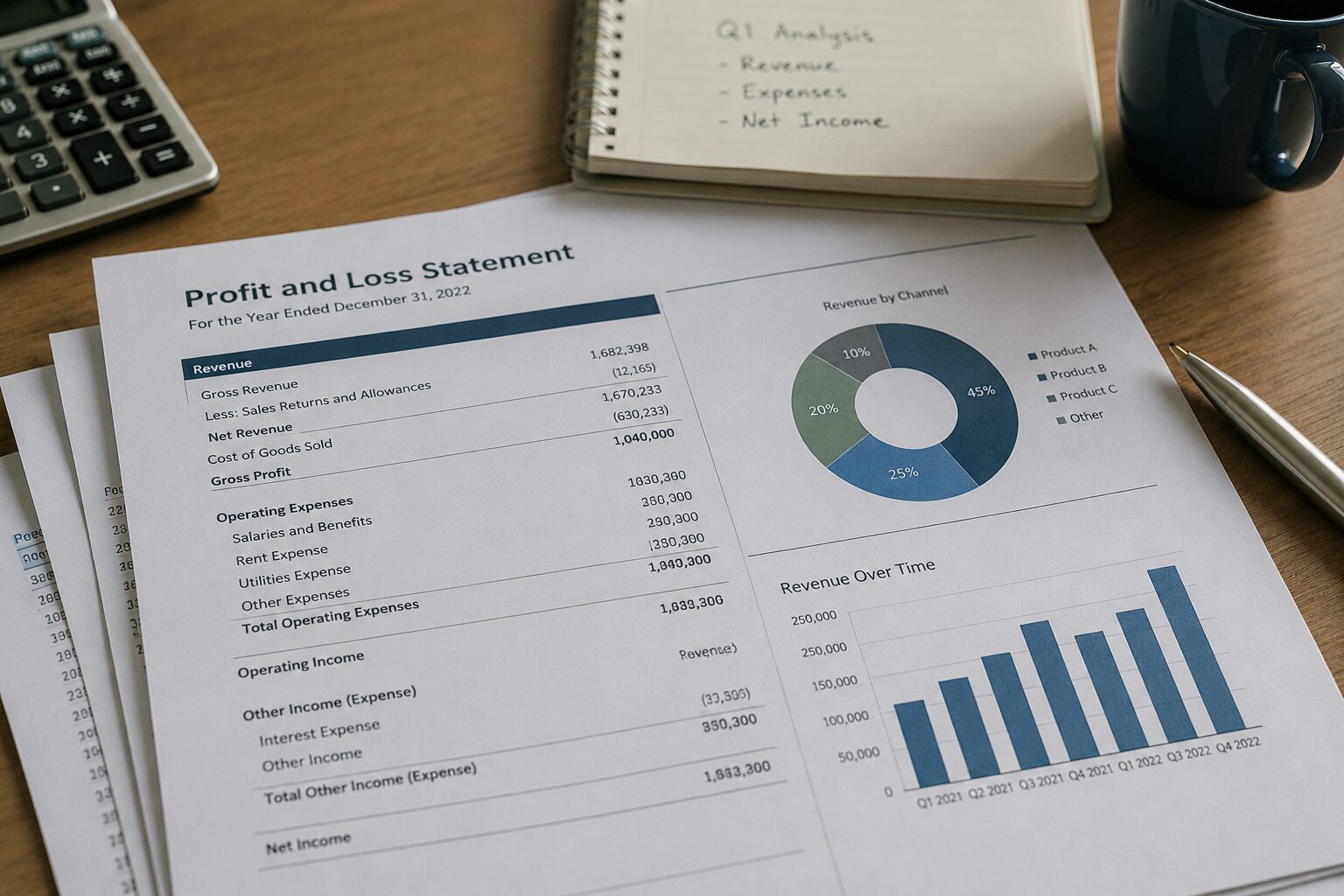
The first line on your P&L is gross revenue. This is the total amount your business brought in before any deductions.
Most business owners stop here and feel good or bad based on this number alone.
A CFO doesn’t.
The first question a CFO asks is: Is this revenue consistent or seasonal and unpredictable?
If your revenue spikes in Q4 and disappears in Q1, that tells a completely different story than steady monthly income — even if the annual totals look the same. Predictable revenue is worth more than high revenue. Always.
The second question: Where is this revenue coming from?
A business that generates $500K from 10 clients is far more stable than one generating $500K from 2 clients. If you lose one of those two clients tomorrow, your business is in serious trouble. A CFO always looks at revenue concentration risk.
The Bottom Line on Your Bottom Line
Your P&L isn’t just a report card — it’s a roadmap. A CFO doesn’t read it to feel good or bad about the numbers. They read it to ask better questions: Where is this revenue really coming from? What’s eating my margin? Are my fixed costs a liability waiting to surface in a slow month?
The business owners who build lasting, profitable companies are the ones who get comfortable in the details. They know that revenue is just the beginning of the story — and that the real answers are buried in the lines most people skip.
So next time you open your P&L, don’t just glance at the bottom line and close it. Read it like a CFO. Your business will thank you for it.