
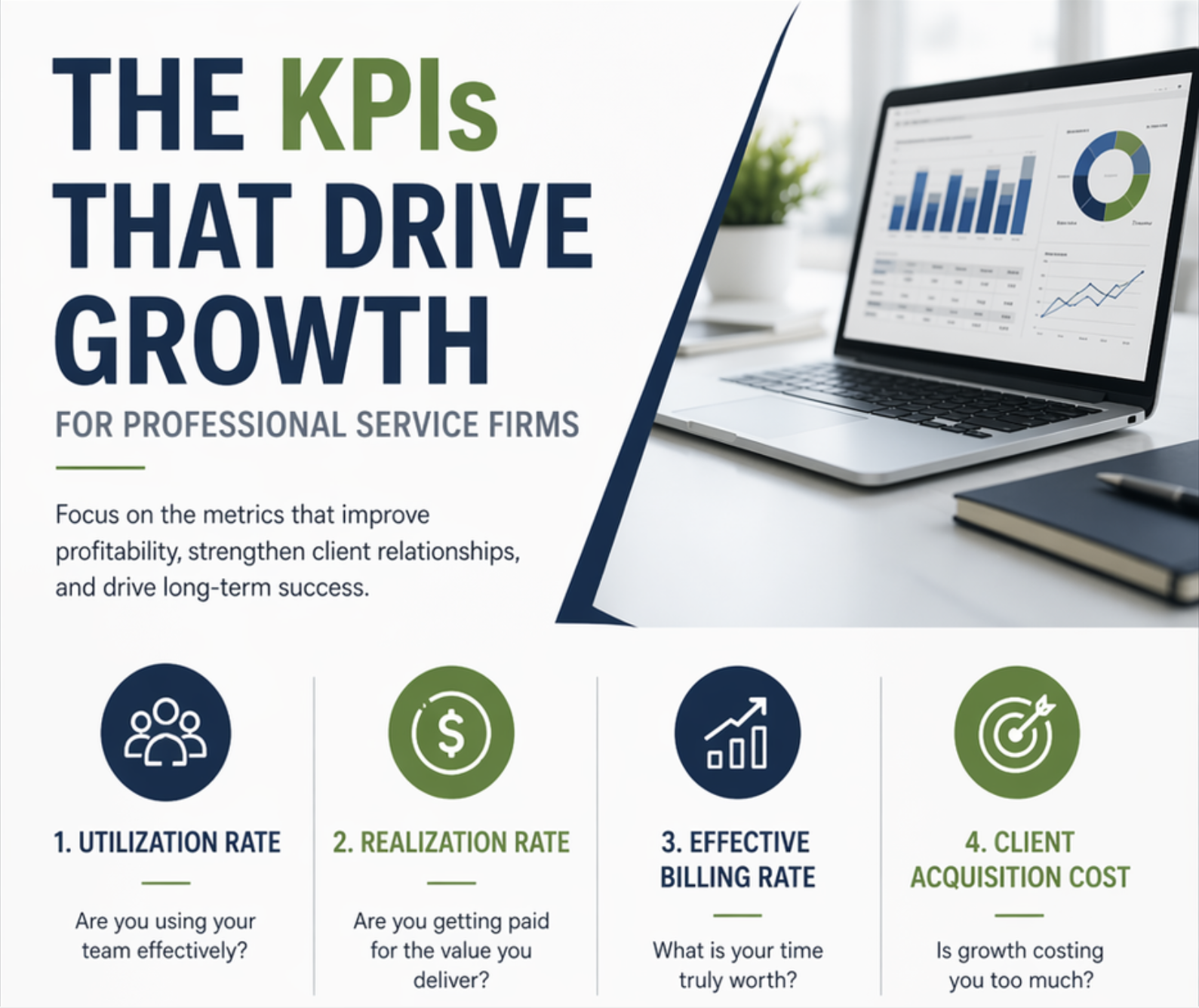
In professional service firms, success is not just about how busy your team is. It’s about how effectively your time, expertise, and client relationships translate into sustainable growth and profitability. That’s where Key Performance Indicators (KPIs) come in.
Unlike product-based businesses, service firms rely heavily on people, time, and client trust. This makes choosing the right metrics essential. Tracking the wrong KPIs can create the illusion of growth, while the right ones provide clarity, direction, and control.
1. Utilization Rate: Are You Maximizing Your Team’s Time?
Utilization rate measures the percentage of billable hours compared to total available working hours. It’s one of the most important indicators of productivity in a service-based firm.
A low utilization rate may indicate inefficiencies, poor workload distribution, or underpricing. On the other hand, consistently high utilization without balance can lead to burnout and reduced quality of work. The goal is to find a sustainable range that maximizes productivity while maintaining employee well-being.
2. Realization Rate: Are You Collecting What You Earn?
Realization rate reflects how much of your billed work is actually collected. It answers a critical question: are you getting paid for the value you deliver?
If your realization rate is low, it could point to issues such as:
- Scope creep
- Ineffective pricing strategies
- Client pushback or write-offs
Improving this metric often starts with clearer contracts, better communication, and disciplined billing practices.
3. Average Revenue per Client: Are Your Clients Profitable?
Not all clients contribute equally to your firm’s success. Tracking average revenue per client helps you understand which relationships are truly driving value.
This KPI can reveal opportunities to:
- Focus on higher-value clients
- Identify upsell or advisory service opportunities
- Reevaluate or restructure lower-performing engagements
Growth isn’t just about adding more clients—it’s about serving the right ones.
4. Client Retention Rate: Are You Building Long-Term Relationships?
In professional services, retaining clients is often more cost-effective than acquiring new ones. A strong retention rate signals trust, satisfaction, and consistent value delivery.
If retention is slipping, it may be time to assess:
- Communication frequency and quality
- Responsiveness and service experience
- Opportunities for proactive advisory support
Strong client relationships are the foundation of long-term success.
5. Profit Margin per Engagement: Are You Pricing Strategically?
Revenue alone doesn’t tell the full story. Profitability at the engagement level helps you understand whether your services are priced appropriately relative to the time and resources required.
This KPI can uncover:
- Underpriced services
- Inefficient workflows
- Opportunities for process improvement
Without this insight, firms risk growing revenue while shrinking profitability.
Turning Insight into Action
Tracking KPIs is only valuable if it leads to better decision-making. The most successful firms regularly review their metrics, adjust strategies, and align their teams around clear performance goals.
If you’re unsure where to start, begin with a small set of meaningful KPIs and build from there. Consistency matters more than complexity.